Campaign to Fight Climate Change, Through Music

In the early 2000s, Al Gore and Kevin Wall set out to create a festival as influential as Live Aid with the purpose of fighting climate change. In 2007, that festival became Live Earth. The concert featured 12 different locations with various artists at each stop. Each location was meant to represent the significance of global climate change. One of the most off beat locations was streamed from Antarctica where five research scientists formed a band in their downtime and had last player for a group of about 30. 

Wall was one of the head creative minds behind Live 8, a benefit concert held 20 years after Live Aid that was meant to bring awareness to global poverty. When discussing Live 8, Wall reflected that one of the major flaws of the concert was not following up after the festival was over and how they were planning to adjust that for Live Earth.

Photo taken from Wikipedia

Putting the festival together in six months was not an easy feat. In the NYT article describing the event, they point out that leading up to the festival, Istanbul pulled out from lack of interest and Brazil was facing conflicts with permission and security. After finalizing the locations and artists, Wall and Gore created a seven-point pledge for viewers around the world to take. The pledge had no real consequences behind lack of following through but was popular because of its accessibility (through text messages). 

One of the major issues with hosting a large scale event that is raising awareness for climate change is that the idea in itself is backwards. The amount of energy and waste put towards a global festival is the antithesis of their original mission. Many of the American artists required a jet to fly to their concert destination and others were criticized for having their songs in the background of S.U.V. commercials. From an event planning perspective, the creators should have made sure that their mission was reflected through the artists and venues they selected. When asked about their efforts in sustainability, the organizers did their best to make the actual concert production as eco-friendly as possible by incorporating solar and wind power to many of the venues.
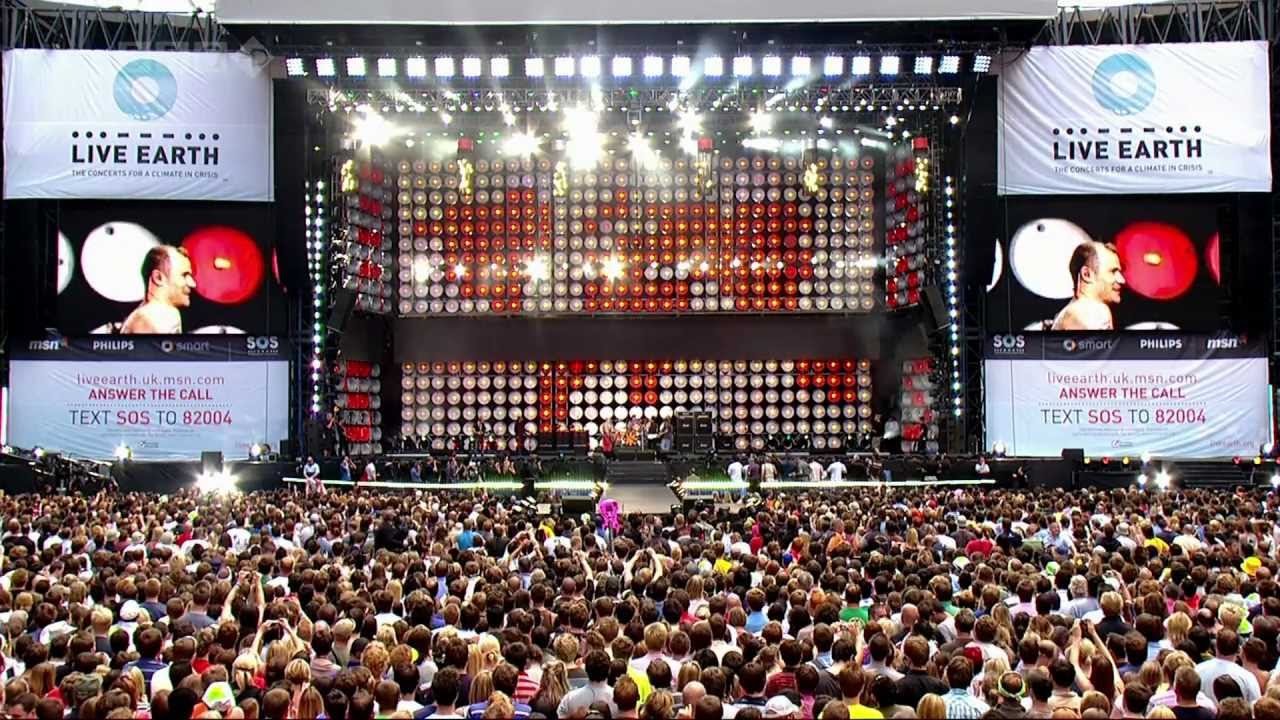
Photo taken from the BBC

Another general criticism about benefit concerts is that people primarily go for the artists but the social change aspect has very little lasting impact on people’s perceptions. Both Gore and Wall had the goal to make Live Earth more about changing individuals rather than trying to change larger organizations. Gore wanted to emphasize the grassroots aspect of the entire event. 

Looking at this event from a 2019 perspective is slightly depressing. The impact of the festival did not seem as great as the creators had expected and very little has been written about the event since 2007, not to mention the fact that the concert was over 10 years ago and the world is only heading towards more climate turmoil. 

After reviewing a few different large scale benefit concerts, it seems that the planning and execution of the events doesn’t always align with the various missions which is the main pitfall. Although music has a large role in bringing people together, it might not have the same effect in changing people’s perceptions. 
Business is Booming (and so is the music)

How Hosting a Festival in Your Town Can Increase Revenue and Tourism

Throughout my blog, I have focused most of my research around a patron’s perspective of a music festival and how that can influence many different factors. As I looked deeper into music festivals around the country, I began to wonder about the economic impact festivals have on their communities.

In one article I found while browsing this search, Rachel Carter, an economist at Mississippi State spoke to the many benefits of hosting a festival, specifically in a small town. Her main points were that festivals can not only boost local economies, but also create an attraction and sense of pride for certain towns. 

Although the Gilroy Garlic Festival isn’t music related, the festival is an example of a town event that can help with recognizability within their state and beyond. The festival brings tourists to the town and can boost local businesses. 

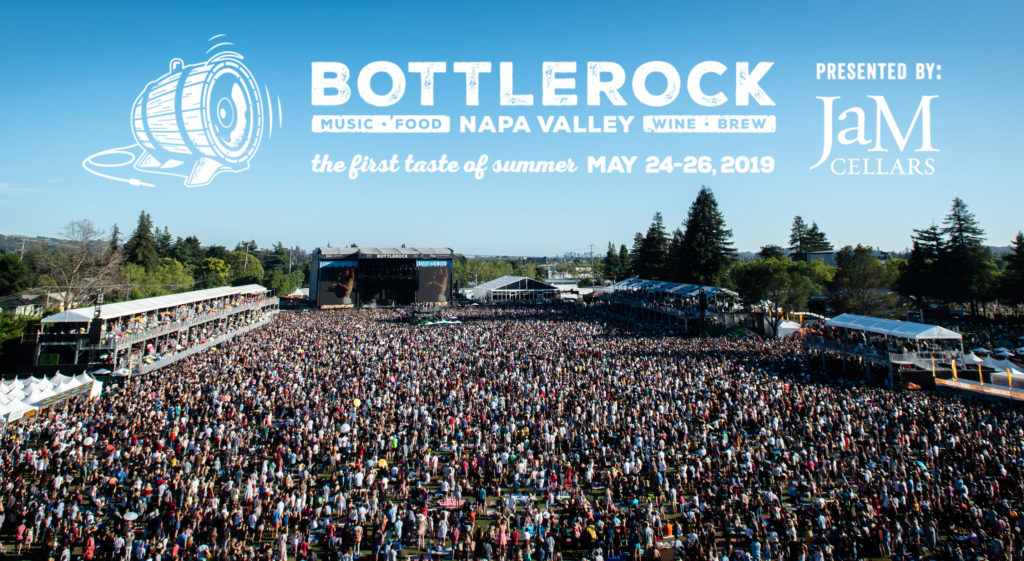
Many music festivals can have the same effect for smaller towns. For instance, festivals like Bottlerock and the Sonoma Harvest Music Festival. Both festivals are put on by the same organization and hosted in the Sonoma area. The festivals offer a venue to showcase what the area is known for, food and wine, while also bringing in tourists year after year . 

Photo taken from the Bottlerock website

When I was browsing the Sonoma Harvest Festival website, I was inspired to write this post because of their suggested lodging and transportation options. The website gave almost no direction or input as to where exactly people should stay but instead eluded to the fact that the area has hospitable options for everyone. Not to mention the fact that the event is hosted at a local winery with local food being served. 

In an article published by University of Minnesota, Ingrid Schneider, director of the University of Minnesota Tourist Center, also spoke to the benefits of having festivals in towns throughout Minnesota. She adds that the social benefits of hosting festivals is equally as important at the economic ones, they are just less visible to the public. She emphasizes that most importantly they can foster pride within a community and strengthen relationships. 

In terms of fostering community pride, many of the smaller festivals can make the biggest difference in communities throughout the US. An example of this is the Hardly Strictly Bluegrasss festival in my hometown of San Francisco. The festival was created as a “Strictly Bluegrass” festival by a local musician who has deep rooted family ties to the area. Once they started bringing in bands that weren’t strictly bluegrass, the festival adopted its new title. Even though the bay area isn’t know for twang or country style music, the (free) event brings the community together and is a tradition that people look forward to year after year. 

Although festivals may seem all about music, there are hundreds of factors that go into crafting, marketing, and executing the perfect festival! And when everything comes together, it can cause magic in a small town. 

Emphasis on the Food

For the past few years it seems that music festivals have been putting more and more emphasis on their food vendors and absolutely no one seems to be complaining about it. While browsing through a few different blogs, it seems that no one can agree to which festival curates the best food lineup which points out the fact that festivals are stepping up their game. 

Throughout the country, most festivals do their best to cater their event with local vendors and have options for everyone (regardless of restriction) and “food lineups” are slowly becoming almost as important as the music. For instance, High Water Fest in Charleston, SC actually posted a “food lineup” to their Instagram and Outside Lands in San Francisco, CA sometimes waits to release the list of food vendors like a separate lineup. The incorporation of local vendors is no doubt a draw to music festivals, but also huge publicity for the restaurants/food trucks and general establishments themselves. 

For many of the vendors that agree to work at the festival, their name and logo are shown on the festival website, written about on different foodie publications and their products are distributed throughout the weekend. 

The Vendors Perspective

In an article published by Inc, Jill Krasny interviewed multiple vendors from Coachella, Bonnaroo and Austin City Limits and the overall response from vendors was positive. Although the days are long and most of the patrons are impatient, serving at a festival is great marketing for up and coming businesses. Salt and Straw for instance, a Portland based ice cream shop, worked the Coachella Festival in 2014 right before opening their LA location. Although the two weeks were a little tough on employees, the company has since opened more shops in the Bay Area and beyond. 

From what I can tell, the festival game is definitely a little more challenging for vendors who aren’t prepared for the mobile aspect of the festival. Most businesses that were already food trucks were aware of all the setbacks that come with being mobile and had a leg up on the competition. Also, for anyone restaurants serving a festival that hosts two back-to-back weekends, improvement was key. Most venders said that they had time to work out the kinks by the second weekend of any of the events they were serving at.  So if you’re highly motived by food, attending weekend two might be the move.

A Patron’s Perspective

As a festival goer myself, I am always intrigued by the food being served at the festival I am attending. Festivals also allow for many attendees to try food they might not know about or have ever tried before and because there are less options, why not try something new. There are even specific foods I wait for at Outside Lands like the pulled pork arepas, spicy tots or chocolate dipped s’mores. No matter the festival, it seems like food is being put at the forefront of the events priority list and adds an interesting aspect to marketing the festivals each year. 

ACL is Giving the Parks Some TLC

For the past 17 years, Austin, TX has hosted Austin City Limits. What started as 2-day festival with tickets selling at 25$ a piece has turned into a 2-weekend, 3-day festival with 450,000 attendees. Throughout the years, the festival has dealt with a few setbacks here and there but has benefitted immensely from their partnering with Austin Parks Foundation. 

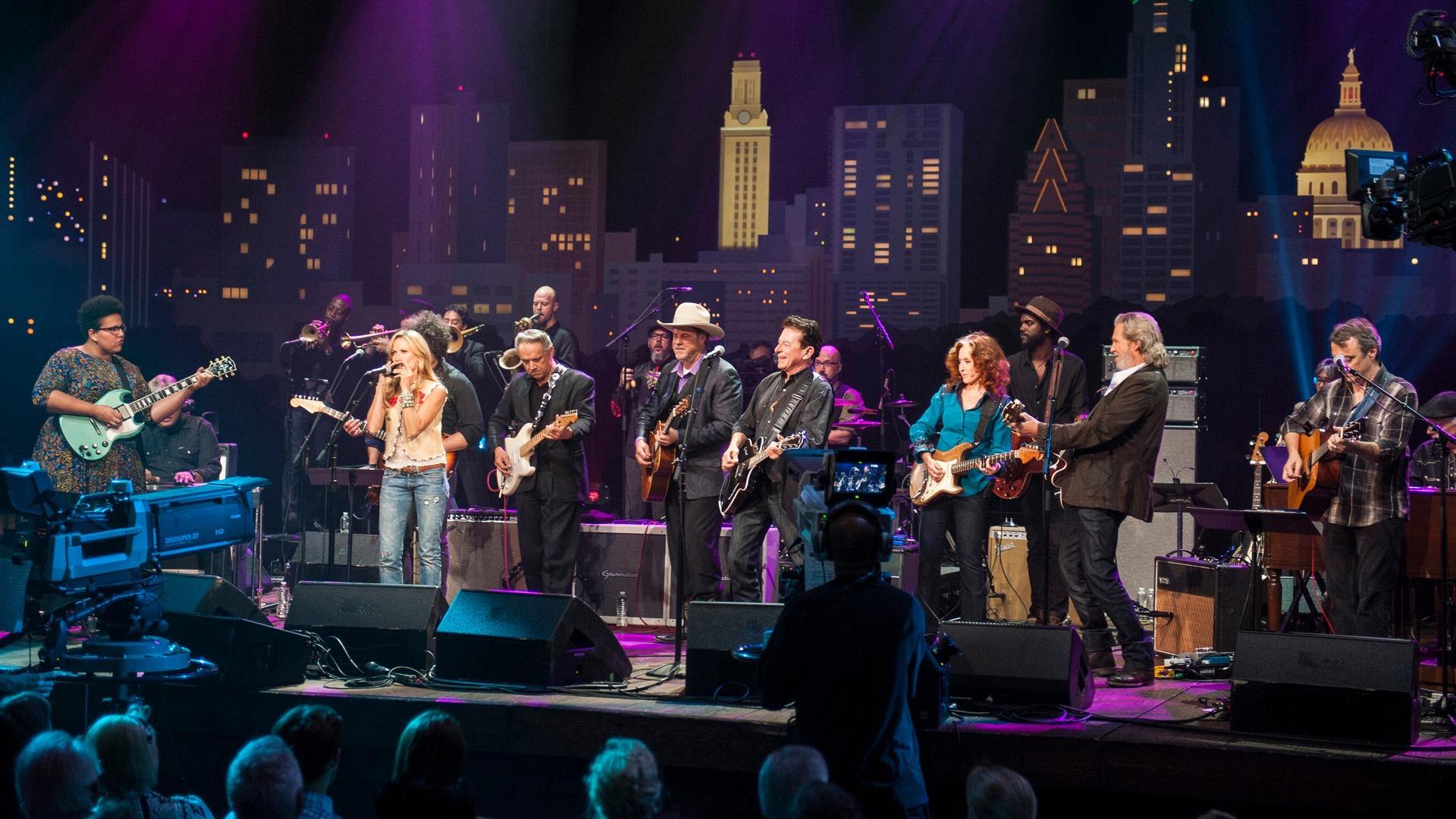
The festival was originally created in response to the television show Austin City Limits on PBS. The show featured two 30 minute segments of musicians from various genre’s playing their music in front of a live audience and being interviewed by the show’s host. The weekly, hour long special was what gave Austin its reputation of “Live Music Capital of the World.” 

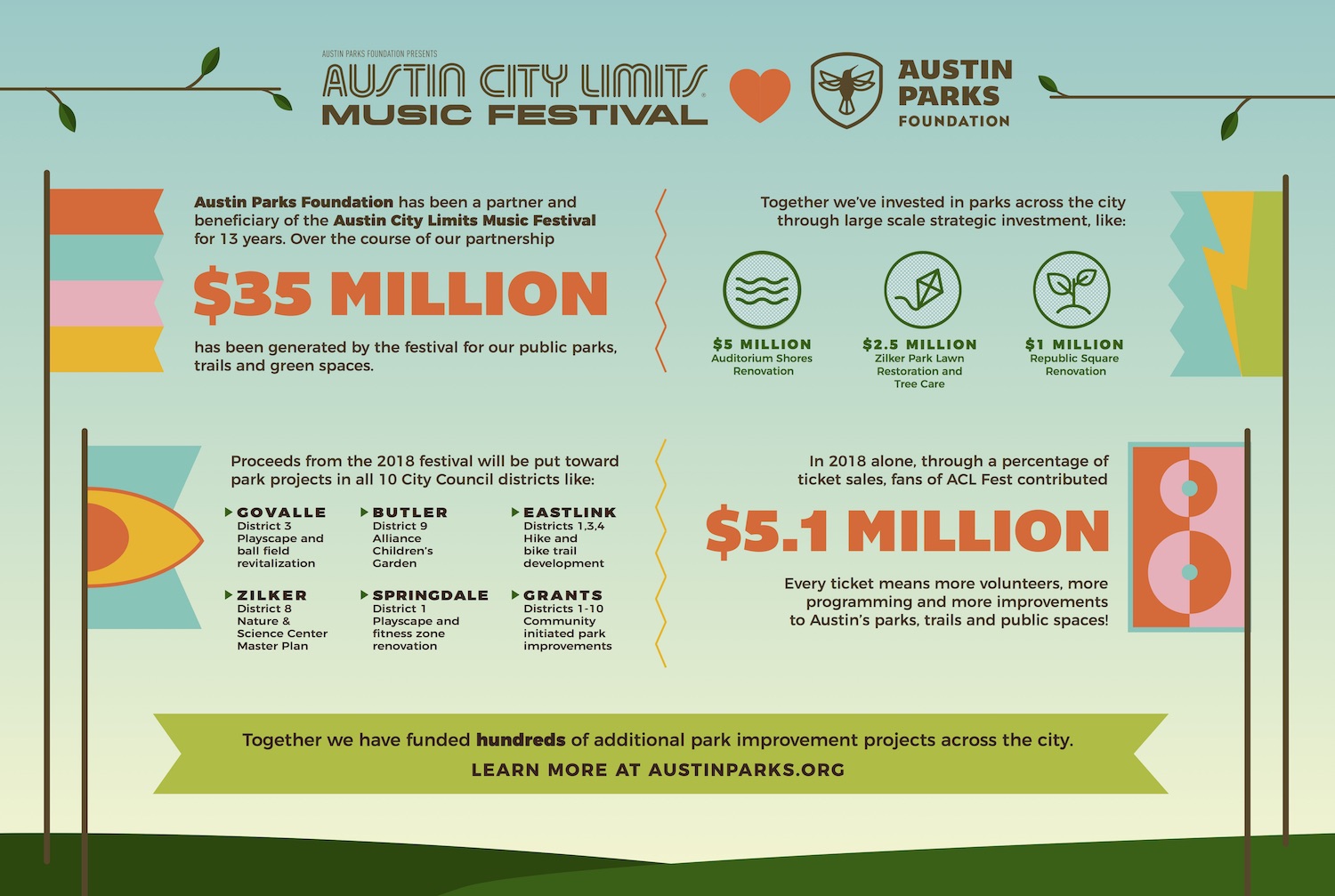
Thirteen years ago, the festival partnered with Austin Parks Foundation and has since devoted part of their mission to sustainability and giving back to the community. The ACL website has a section dedicated to sustainability which features brief captions about their various efforts and each year they use data visualization techniques to highlight their previous success. 

Image Curtesy of PBS

How They’re Helping

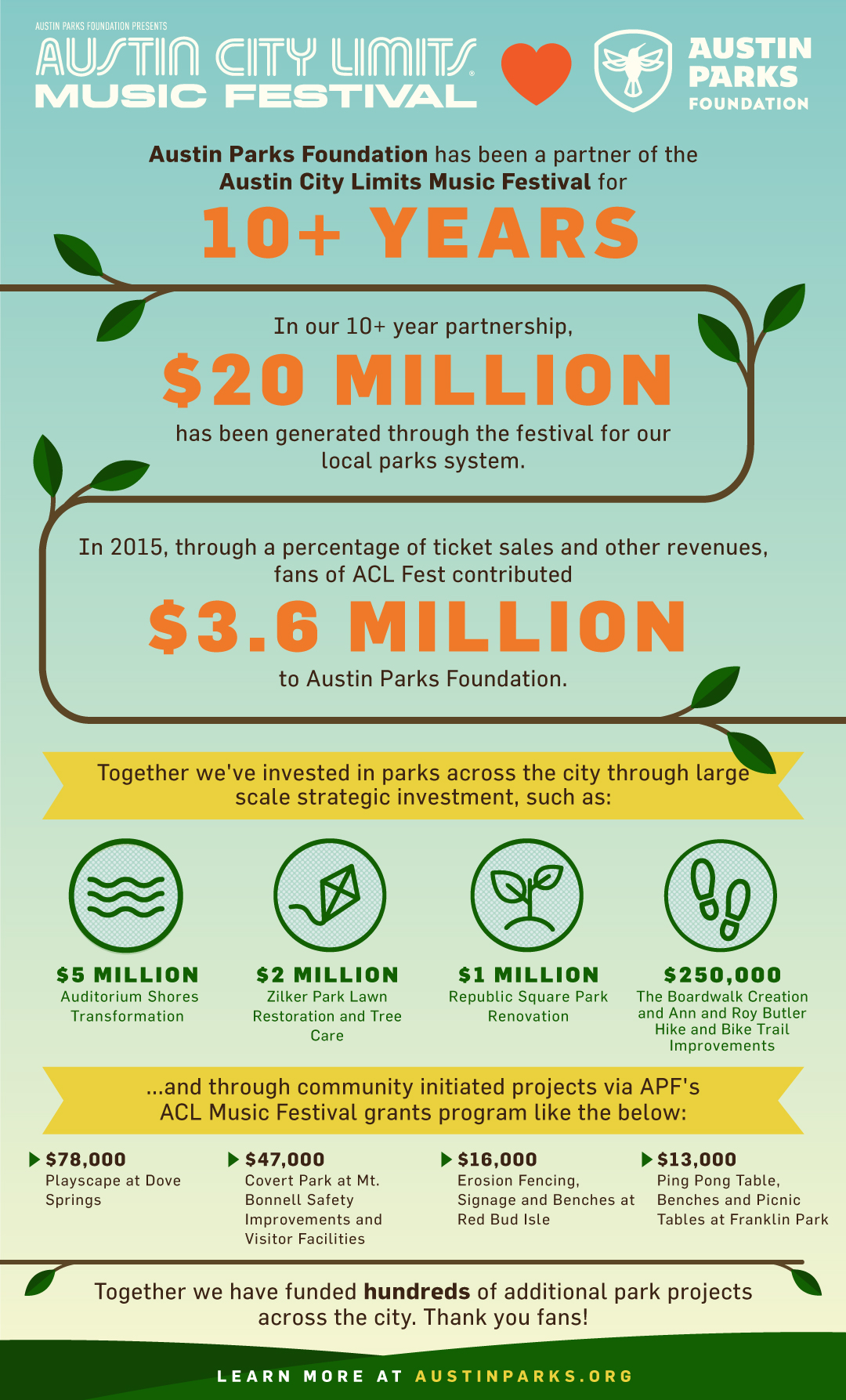
Although this idea of festival sustainability is nothing new, ACL has a special twist on how they are improving their local parks. According to their “sustainability report” (which is actually just an infographic) the festival has generated $35 million towards supporting public parks, trails and green spaces. 

The money has gone towards multiple park restoration projects, specifically Zilker park where the festival is held each year. The ticket donations have also allowed APF to create programs centered around community engagement, like adding ping pong tables and picnic benches to local parks. 

Image Curtesy of Austin City Limits Festival

ACL Festival seems to represent the city as a whole, one that is young, trendy and up-and-coming for millennials. That vibe is also reflected through their website which is informational but also brief. Their sustainability tab is broken into five different sections and each section has descriptions of ‘why it matters’ and ‘what you can do.’

Why They Should Be Using Graphics 

The infographics the website has used over the past few years have a similar and simple theme and highlight most of the same information but are important to include, especially if they are using the graphics at the festival. Most of the festival attendees are going to listen to the music and generally experience the festival while the sustainability and charitable work are somewhere in the background. Infographics at the festivals are important because they allow for festival goers to absorb some impactful and important information without having to stop what they’re doing while cruising around the event. 

Grass Lands: Hot or Not?

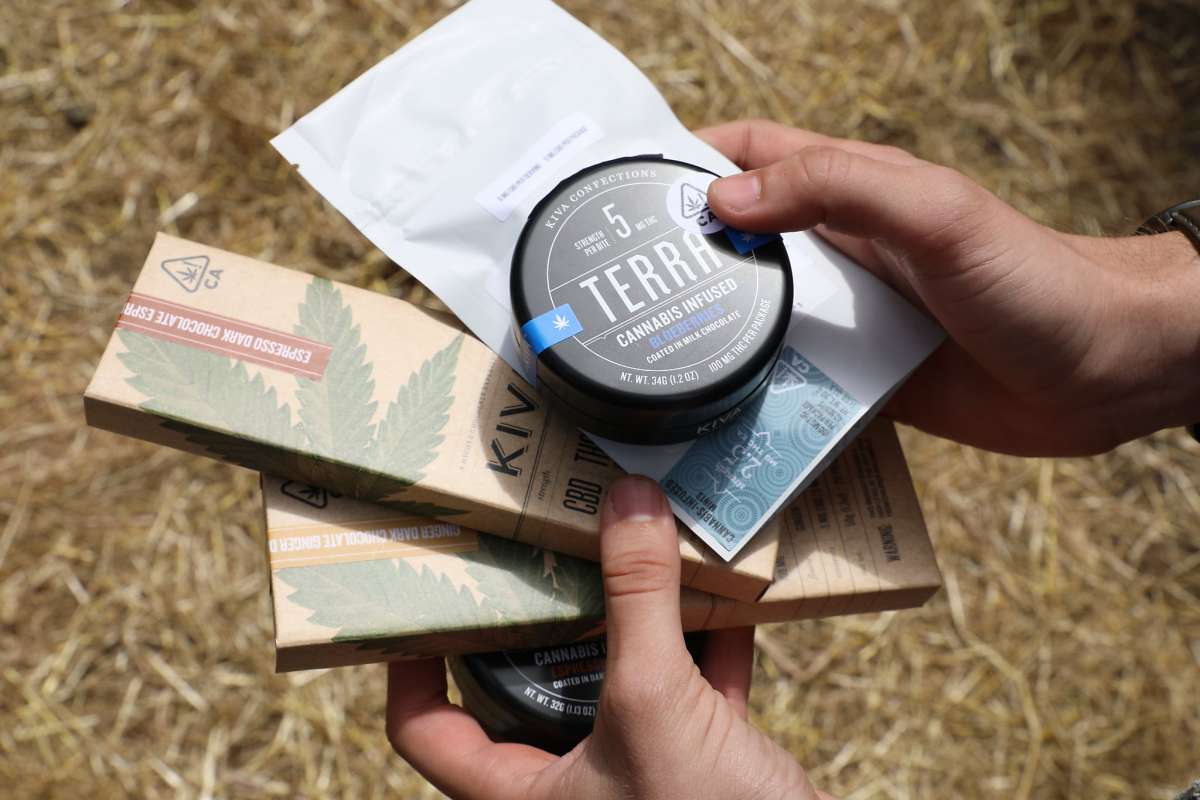
OSL hosting a weed themed section of the park? Talk about something that is on brand. Last year, Outside Lands became one of the first festivals to have a section of Golden Gate Park dedicated to marijuana that every single publication on the internet has been calling “the first major US music festival to have a curated cannabis experience.” The one drawback for most fanatics: you can’t smoke in a public park so Grass Lands had a look, don’t touch vibe.

Grass Lands featured a range of activities for marijuana enthusiasts, including booths with budtenders, lemonade stands, flower crown making and a “smell wall.” According to Superfly’s co-founder, the incorporation of Grass Lands was meant to celebrate the legalization of weed in California and show off what local plants the state has to offer. The “curated experience” is a complement to Wine Lands which highlights Napa Valley and Sonoma’s extensive wine offerings. 

Grass Lands is back for 2019 with most of the same events, but would we consider their first year a success? When reading the responses to Grass Lands in 2018, journalists and people hired to speak about the event sounded excited about how the first year played out. But after browsing through Reddit, the fans might feel a little different. 

The idea of having a cannabis curated experience and calling it Grass Lands can be very deceptive to an unaware festival goer who might be looking to smoke before the next show. From what I can tell on Reddit, Grass Lands was a bit of a flop. The event is understandably disappointing to anyone interested in consuming any marijuana at the festival. 

Most of the critiques from the patrons at the festival centered around the idea that no actual smoking was taking place at Grass Lands. One person on Reddit even pointed out that they personally were smoking everywhere throughout the festival except for Grass Lands while another said that everyone was simply missing the point of the entire set up. 

Photo from SF Chronicle

Overall, it seems like Grass Lands could use some work. Although it’s “fun” for a festival in San Francisco to celebrate the legalization of weed in California, the branding of the event seems all wrong. I was not able to attend Outside Lands last year, and up until doing further research I thought people were able to smoke at Grass Lands, just like the many other festival goers disappointed with the area. 

In terms of educating the public and de-stigmatizing marijuana use, Grass Lands was a success. For future festivals, Superfly should work to publicize a bit more about what the event has to offer so that people aren’t quite as disappointed when they get there. 

Watch Out Measles, There’s a New Outbreak in Town

In the past few weeks, the measles outbreak has been all over mainstream media. Throughout the country, lack of vaccinations has been wreaking havoc everywhere from schools to farmer’s markets. The measles outbreak has been the perfect distraction from the alleged herpes outbreak at Coachella weekends one and two and Stagecoach the following weekend.

Both festivals are hosted at the Indio Empire Polo Club for three consecutive weekends and it seems like Coachella may have a crisis on their hands. It’s not surprising that an outbreak like this would happen at one of the most heavily populated music festivals in the country but now I’m wondering if there is a way to stop it?

Photo from @stagecoach twitter account

According to an app called #HerpAlert, there was an enormous surge of reports through the app in the southern California region that seem to be linked to the music festival. So far Coachella has yet to say anything on the matter. In a recent posting from Daily Wire, apparently 250 reports were made from the festival per day compared to the average 12 reports on any other given day from the same area.

Logo From LinkedIN

The Daily Wire article also points out the fact that music festivals are not only the place to spread diseases because of the hook-up culture at festivals, but are the perfect place to spread herpes from the constant sharing. 

Coachella should be aware of this for next year and make sure to post helpful tips about how to stay clean at the camp grounds and around the festival. Herpes especially can spread from sharing sips of water, cigarettes, lipstick or anything else that might come close to your mouth, which means almost any kind of relationship (new or old) at the festival could have experienced a problem. Although most events have medical tents and on site health care providers, the festival should also make a point to provide patrons with advice and tricks to stay as healthy as possible at their events. 

Photo taken from Pinterest

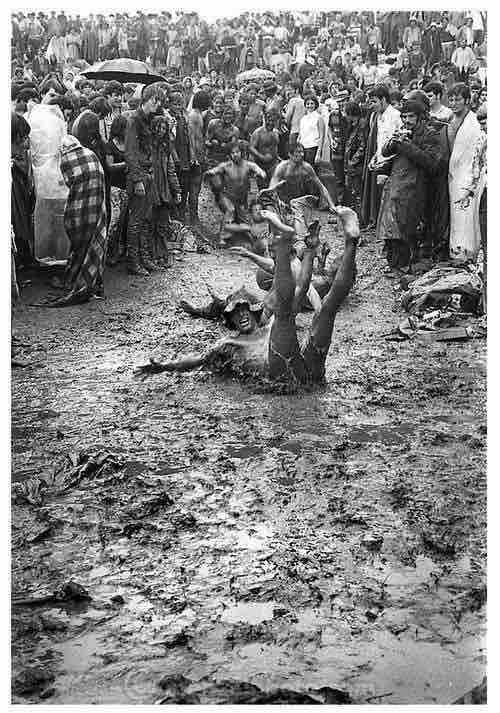
This idea of disease due to crowds is not new for music festivals and was very prevalent at the age-old festival, Woodstock. The 1969 event drew a crowd of 300,000 people and was ridden with drugs, sickness and overall uncleanliness. At the time, many of the sicknesses were caused by the usage and selling of “bad drugs” and the medical tents were dealing with more than 1000 people in one day.  

Lucky for Coachella and Stagecoach, music festivals have managed to clean up their act since Woodstock, but all upcoming festivals around the country should be on the look out this year and try to help patrons stay clean from any STI’s. 

Billie Eilish – Why She Works

If you have turned on the radio, or looked at any US music charts within the last year or more specifically within the last five weeks, you’ve probably encountered Billie Eilish. The 17-year-old prodigy released her first full album 2 weeks before performing at Coachella and doesn’t seem to be slowing down any time soon. 

So what has led her crazy success? Aside from her beautiful voice and the fact that her music is the perfect balance between emo and pop, her blunt, to-the-point attitude has seemed to fascinate fans and journalists. Eilish came into the spotlight when she was 14 with her first single “Ocean Eyes.” In radio and video interviews she seems to represent every teenage girl going through all the feels of rejection, sadness, and general ‘earth shattering’ teen dilemma’s. 

She represents everything that Disney teens don’t which has seemed to be her biggest selling point. She was only 11 when she first started writing songs and had no interest in being fake or innocent. Another stand out quality about Eilish is her fashion sense. She’s constantly in loose fitting, highly accessorized looks, with an emphasis on androgyny. 

Her mix of rock, pop, hip-hop, and electronic is something most people haven’t encountered before and definitely not from such a young star. When asked about her age Billie usually scoffs and has no good response; to the average person being as successful as she is at a young age sounds overwhelming but for Billie it’s her reality.  

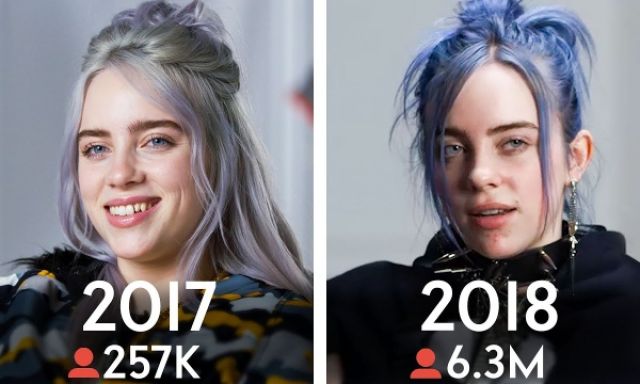
In a recent interview with Vanity Fair, Billie answered all the same questions she had previously answered in an interview one year before with the magazine. The touching and wholesome video humanized Billie in a way most artists can’t show their fans. Although her vibe is standoffish and angsty, the video does a perfect job of showcasing how much she achieved in one year and how much she has grown in herself. 

Image from https://entertainment.ie/music/billie-eilish-does-the-same-vanity-fair-interview-one-year-apart-and-it-is-intense-384552/

The beginning the video starts with basic questions, like how many Instagram followers she has and the biggest crowd she’s ever played for, but as the video goes on, they ask questions that dig deeper into the life of Billie Eilish. When asked what advice she would give to herself in a year, the younger Billie answered by saying not to waste so much time on being sad. Watching the reaction she has one year later made Billie the most relatable 17-year-old even if her lifestyle is not relatable whatsoever. 

Though her career is only just beginning, Billie has shocked the music industry with her success which I think must be attributed to her image and brand, along with her incredible talent. Were all just waiting to see what Billie does next. 

The One Bandwagon That Might Work: Sustainability

Photo taken from the outside lands website

There’s no city quite like San Francisco to hop on a trend but in term of environmental awareness they seem to be pioneers. I remember when I was about 8 years old, a figure somewhat similar to Big Bird came into my 3rdgrade classroom to explain composting. It was so long ago that all the details are slightly mixed up but it serves as a reminder of how long San Francisco has been saving the planet. And their music festivals are no exception. 

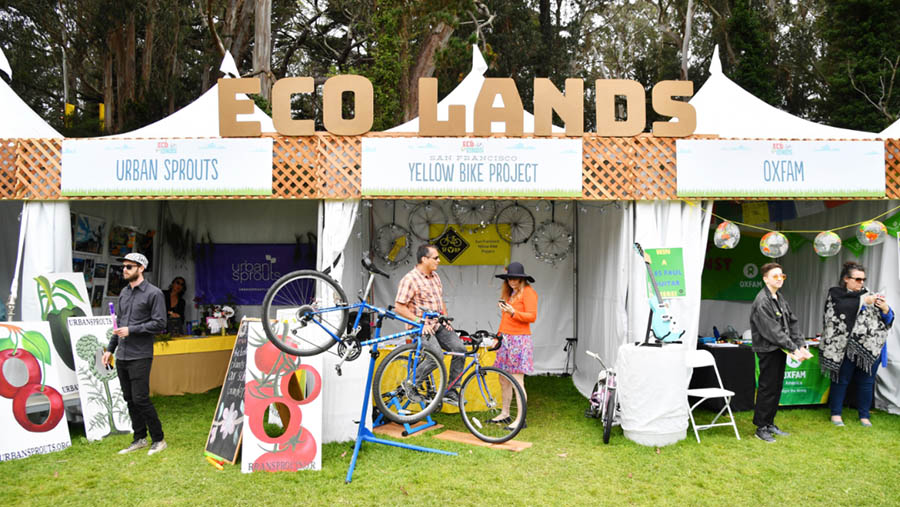
Outside Lands, the cities biggest music festival, has been working on sustainability since its creation in 2008 and has not lost sight of its mission for the past 11 years. In 2009, one year after the festivals debuted, the creators introduced Eco Lands, which devoted a section of the park to educating about sustainability. The festival also teamed up with PG&E to create interactive stations like a solar powered charging hub and a fully solar powered stage. 

Photo taken from https://inhabitat.com/eco-lands-sfs-outside-lands-festival-grows-a-green-heart/

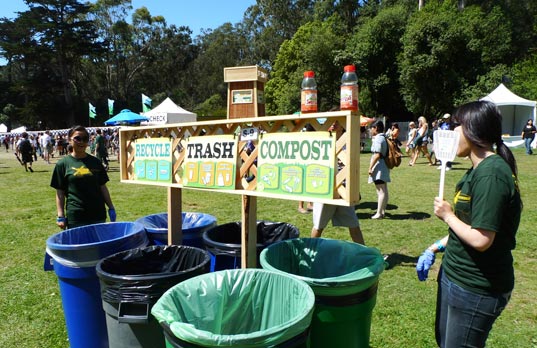
In terms of social responsibility, Outside Lands is one of the leaders among all music festivals, and they go so far with their sustainability efforts that nothing feels like an act to the consumer. The first year that Outside Lands introduced Eco Lands they had workers standing at each waste station with fly swatters to slap the hands of irresponsible festival goers that weren’t separating their trash properly. Along with their eco-friendly initiatives, Outside Lands offers a farmers market to promote local produce and sustainability through the food we eat. In 2018, OL diverted 92% of all waste from landfills.

The festival does not only promote sustainability, but also gives back to the community. According to their website, the festival has created a subsection called Outside Lands Works which is meant to promote music and arts education within the Bay Area. Through their ticket sales, OL donates to eight different organizations that support mental health, empowerment and community engagement through music. 

This focus on social responsibility is rooted in the fact that Outside Lands is put on by Another Planet Entertainment (APE), a Bay Area born music company and the work APE does with Clean Vibes. Starting in 2003, APE has worked tirelessly throughout San Francisco, Oakland and the outer bay area. Just five short years after creating APE, the company was able to pull off Outside Lands which was their first major festival. Since then they have hosted another 11 OL festivals and created Life is Beautiful, Treasure Island Music Festival and Clusterfest along the way. 

As a developing entertainment company, APE has done an incredible job of keeping social responsibility at the forefront of their work, which is shown through the successes of the brand and each event they sponsor. Not only do they keep San Franciscan’s happy with their efforts at Outside Lands, they have set a new standard for sustainability at festivals around the country and they’re hoping everyone hops on that greenwashing bandwagon.

Is Gospel the New Pop?

If you’re anything like me, and like to religiously keep up with the Kardashian’s, then you know that if you could be anywhere on a Sunday it would be at Kanye’s Sunday Service. What started as a mysterious, neon-centric, gospel concert has now developed into an exclusive and intricate production that is only open to Kanye’s close friends and family. Except this past Easter Sunday when Kanye opened his service up to the public at Coachella Weekend 2. 

As someone who grew up going to church on Sunday’s in the middle of San Francisco, I was very aware that practicing religion wasn’t exactly “cool” or “trendy.” But, have the tides started to shift in a different direction?

The first time I remember seeing a trendy celebrity openly pray and thank god was when I was around 13 years old and saw Justin Bieber’s movie “Never Say Never.” In the movie, Bieber circled up his manager, band members, and his mother to pray directly before going on stage. It undoubtedly contributed to his image of being a young, innocent adolescent who felt genuinely blessed about his fame and accomplishments, but also felt awfully staged at the time. 

This idea of religion being seen as a faux pas is nothing new.  As I’ve grown up, I’ve become accustom to sports broadcaster tending to shift away the post-game interview questions when players begin to thank God.

https://www.foxsports.com.au/basketball/nba/nba-steph-curry-reaches-out-to-young-fan-riley-morrison-who-asked-why-his-shoes-were-only-for-boys/news-story/1583da8e898ff5183c5d716f3186ee1e

Recently, I have noticed an interesting resurgence in religion in terms of people incorporating their beliefs into their personal brand, like Kanye West, his sister-in-law Kourtney or athletes like Stephen Curry, who sends up a small prayer after each shot he makes. 

In a recent interview with Jimmy Kimmel in LA, the Kardashian sisters answered a series of questions about Kanye’s Service and the responses caught my attention. Each service features a gospel choir performing a host of songs, some by Kanye himself and other popular hymns.

When asked if the service was religious, Kanye’s wife, Kim, seemed to avoid the question and said it was “spiritual” but did not want to make the event seem “exclusive” in terms of religious beliefs. Her sister Kourtney, whom often shares biblical verses on her social media was quick to point out that the services are “definitely Christian.” Kimmel in response to that almost immediately brought up a new topic of conversation, and then Sunday Services were not talked about again.

This idea of Christianity shifting someone’s brand is not necessarily common in the entertainment industry but the tides may be shifting towards a pious trend. 

Live Aid Lives On

When looking back at some of the most iconic festivals in world history, many of them were not created for sheer entertainment but for something much bigger than that. Whether it be for famines, violent attacks or natural disasters, benefit concerts tend to draw the best crafted line-ups of all time. 

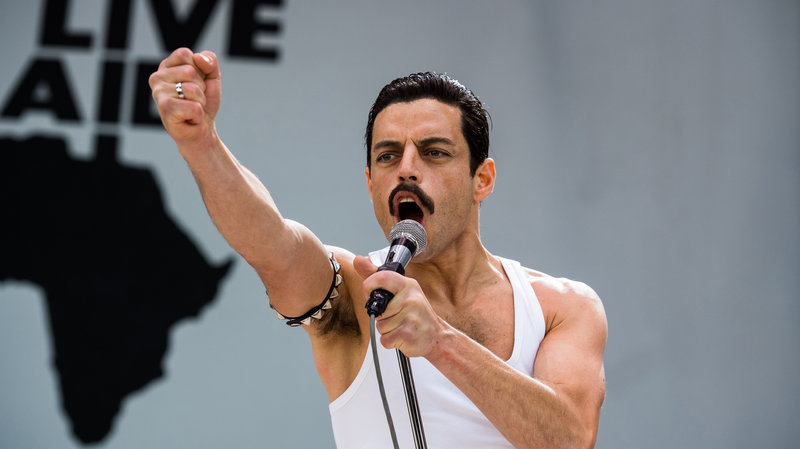
https://www.npr.org/2018/11/21/669850052/you-better-own-this-how-rami-malek-came-to-embody-freddie-mercury

With the recent release of “Bohemian Rhapsody,” the movie, Live Aid has constantly been on my mind. As I watched the final scenes of the movie, and tried to consume as much Wikipedia as I could, I actually sat in awe and sadness thinking music would never be that good again. It took me, honestly, a few days to recover.

When my parents recently came to visit me at college, they were shocked that all my friends were flawlessly belting the words to “Bohemian Rhapsody” and “Don’t Stop Me Now” which were both released before my mom entered high school. But, certain music will seem to always stand the test of time which is why Live Aid is still so iconic now.  

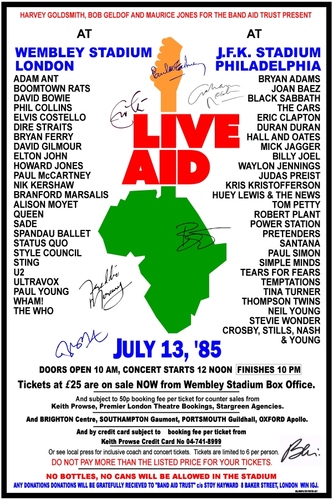
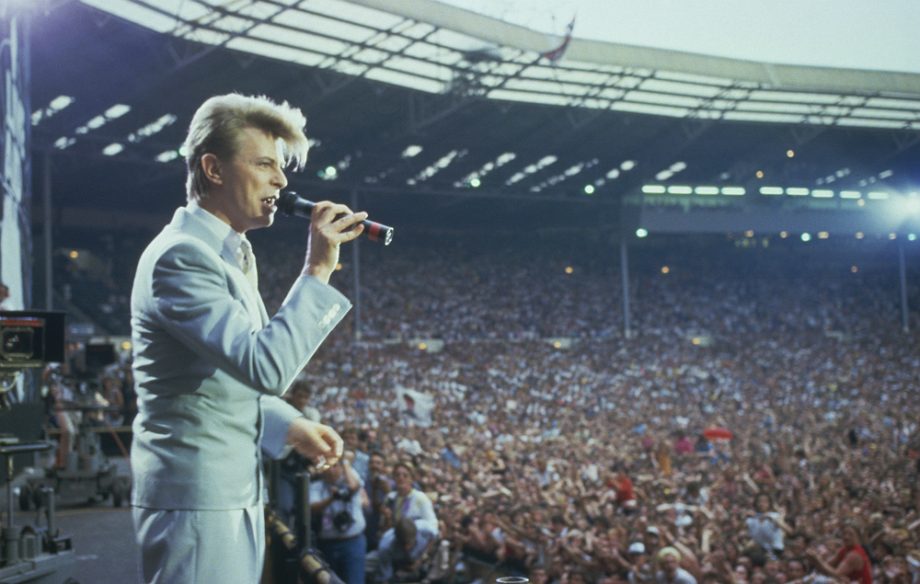
Headlined by Queen, Elton John, David Bowie, The Who and Paul McCartney, there are few benefit concerts that could ever compete with the talent at Live Aid. Not to mention the Philadelphia location hosting Bob Dylan, Hall & Oats, Mick Jagger, Led Zeppelin, Madonna, Tom Petty and more!

https://posteralley.ca/product/live-aid-1985-concert-poster-with-signatures/

Interestingly, many people debate whether Live Aid actually made a difference in the Ethiopian famine. Some say the concert actually had very little financial impact in Africa but did help with awareness of issues going on abroad. 

From the artists perspective, there was almost no way to go wrong at this festival. It was the ultimate showcase of musicians and performing at the show not only meant that they cared about humanitarian issues, but they were also at the top of their craft. 

When I began to think that music would never be as good ever again, I started looking into more recent benefit concerts that my children might once look back at and envy that I lived in that time. While researching this topic I found an article where Bob Geldof (Live Aid’s creator) said that in the new age of social media and the internet, a benefit concert like Live Aid wouldn’t ever work again. He thinks that people’s access to donating to specific causes is so easy that they don’t feel the same urge to donate at a big festival.

https://www.nme.com/news/music/live-aid-return-bob-geldof-discusses-2205618

After the release of Bohemian Rhapsody, I’m not so sure he’s right. With the creation of social media, people are more motivated than ever to attend popular events, especially if music is involved and even better if it enhances their reputation! 

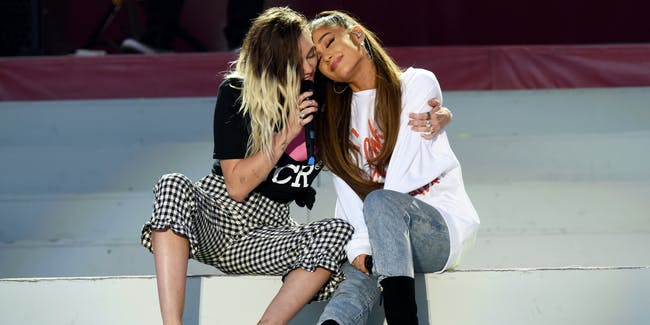
Unfortunately, benefit concerts have seemly started to slow in popularity and the most recently famous benefit concert was One Love Manchester created by Ariana Grande just two weeks after someone released a bomb at her Manchester tour stop. The event received heavy media coverage in the UK but still made US news because of artists like Miley Cyrus, Justin Beiber, Katy Perry and Mac Miller.

 Overall the festival did what it set out to do but Bob Geldof might be right that the impact of benefit concerts has decreased significantly with younger generations.

https://www.inverse.com/article/32578-ariana-grande-one-love-manchester-benefit-concert-performers-twitter-reactions
A Fendi For Your Thoughts

A Fashion and Lifestyle Blog

Within Earshot

Calling All Festival Fanatics

Discover WordPress

A daily selection of the best content published on WordPress, collected for you by humans who love to read.

The Atavist Magazine

Calling All Festival Fanatics

Design a site like this with WordPress.com
Get started